What is the best placement for a tattoo?
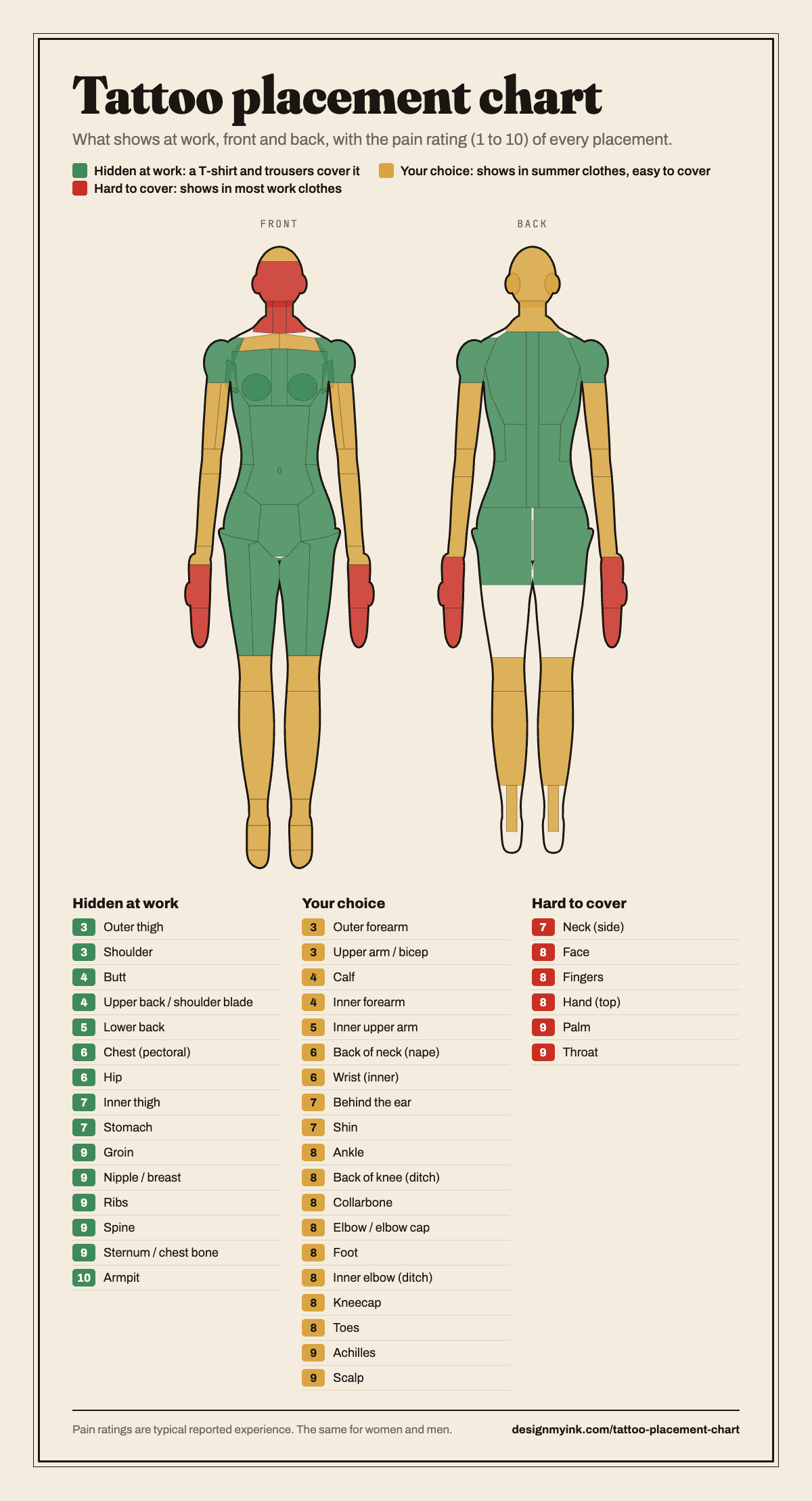
For most people, the outer forearm, upper arm, shoulder, outer thigh or upper back. They rate 3 or 4 out of 10 for pain, hold their lines well and leave room for the design to grow. The best spot for you also depends on whether you want it on show at work and how big the design is, which is what the filters on this chart sort out.
Where can I get a tattoo that is hidden at work?
15 of the 40 placements on this chart are covered by a T-shirt and trousers: the shoulder, armpit, outer thigh, inner thigh, butt, ribs, sternum, stomach, chest, hip, nipple and breast, groin, upper back, lower back and spine. The least painful of them are the shoulder, outer thigh, butt and upper back, all rated 4 or less.
What is a good placement for a first tattoo?
Pick somewhere padded that heals without fuss: the outer forearm, upper arm, shoulder, outer thigh, inner forearm, calf, butt and upper back. All rate 4 or less for pain. The lower back and inner wrist also work if you accept a little more sting.
Which tattoo placements age best?
Spots that stay out of the sun and do not crease or rub: the inner forearm, upper arm, inner upper arm, shoulder, outer thigh, butt, ribs, sternum, chest, hip, upper back, lower back and spine. The ones that fade fastest are the inner elbow, elbow, inner wrist, kneecap, back of the knee, ankle, Achilles tendon, face, back of the hand, fingers, palm, foot and toes, because of sun, friction or skin that bends all day. Sunlight breaks tattoo pigment down (a lab study watched natural sunlight destroy a common red tattoo pigment), so sunscreen on visible tattoos keeps them sharp for longer.
What size tattoo fits each placement?
The skin behind the ear, fingers and toes suit only tiny pieces under 2 inches. The outer forearm takes anything from small (2-4") to large (6-10"). Only the upper back takes a full piece over 15 inches; the upper arm, outer thigh, butt, ribs, stomach and chest top out at 10 to 15 inches.
Does placement change the price of a tattoo?
Yes, through time in the chair. In our cost calculator the same design takes about 10% longer on the back, chest, shoulder or stomach than on the forearm, thigh, upper arm or calf, and about 25% longer on the ribs, hands, feet, neck, elbow or knee, where angles are difficult and the skin is harder to work. An outer forearm piece typically costs $180 to $1,080 with an established artist in a mid-size US city, depending on size; an upper back piece, from medium to full, costs $395 to $4,950.
Is tattoo placement different for women and men?
The ratings on this chart are the same for both. In a 2020 survey of 1,092 tattooed adults in Poland, women and men reported similar pain during the session (4.3 and 4.5 out of 10, not a significant difference), but they chose different places: women more often the torso (35% of women against 21% of men), men more often the arm (57% against 42%).
What are the names of tattoo placements?
Artists use a few names that are not obvious. The ditch is the inside of the elbow or the back of the knee, the sternum is the centre of the chest, the nape is the back of the neck, a sleeve covers the arm from shoulder to wrist (a half sleeve stops at the elbow), and a back piece covers the whole back. This chart names 40 placements, grouped as arms, legs, chest and torso, back, head and neck, and hands and feet.